

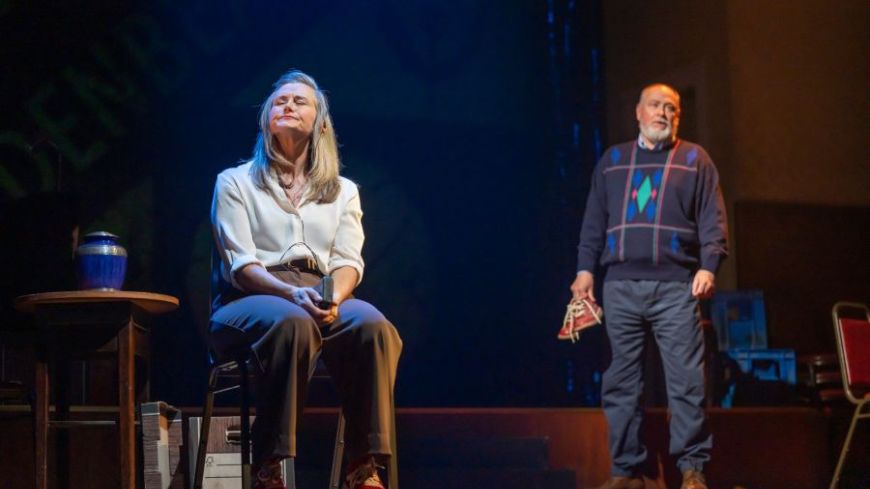
‘’The opposite of winning is not losing, Sally, its hope,’’ or at least this is what Cowdenbeath football club fans are forced to believe. Based on the 1993 book of the same title by Ron Ferguson, Black Diamonds and the Blue Brazil is a story of loss, hope and home, told through the triumphs - and perhaps more relevantly for this story, the defeats - of a beloved local football club.
Gary McNair’s stage adaptation cleverly conveys the loyalty, sentimentality and hope that come with supporting a local football team. We watch Sally, played by Dawn Steele, as she unwillingly finds herself praying for just one Cowdenbeath win in order to honour her late father’s final wish.
The story begins with Sally breaking the fourth wall to introduce the audience to the uncelebrated world of Fife’s Cowdenbeath - or more specifically, Cowdenbeath FC, a team we quickly learn is no stranger to defeat.
The stage set, resembling the familiar function room of a small-town football or social club, complete with old pub-style stools and doors, becomes the foundation for a story that spans many years and locations. From Sally’s London living room to her father’s house, the production always seems to find its way back to Central Park Stadium in Cowdenbeath.
Sally’s father, played by Barrie Hunter, appears mostly through flashbacks from Sally’s childhood and adult life, explaining his devotion to his football club and its players. At one point, he sits Sally down to tell her he has a disease - “mad Cowdenbeath syndrome” - in one of several hilarious scenes from Hunter.
Hunter’s monologues, conversations with Sally and impeccable comedic timing make the show memorably funny. His character perfectly depicts the dynamic between an ambitious daughter, uninterested in football and desperate to leave her hometown, and a football-mad father determined to prove the greatness of both his town and its team.
The highlight of the show, however, is the music written and performed by Ricky Ross, seated at a piano in the corner of the stage, ready to heighten every emotion with his beautifully written songs and raspy voice. Ending on “Come Home”, each musical interval is timed perfectly to moments of humour, desperation and sadness - accompanied at times with a screened projection.
Using only two actors, the play is almost as simple as theatre can get, relying heavily on the audience’s imagination. However, Dawn Steele’s embodiment of the many characters Sally encounters along the way is as clever as it is funny and charming, and the personality of each character remains distinct throughout, even without additional actors - though this would have been appreciated.
While the show is versatile in its themes, it undoubtedly speaks most strongly to a Scottish audience, with references to football teams across Scotland and Fife adding an extra layer of humour and familiarity, although perhaps not so relatable for non-Scottish audience members.
As we follow Sally on her increasingly exasperating journey to witness a victory - ‘’Just ONE win! How hard can that be?!’’ - we watch her begin to understand the same emotional investment her father felt for a team that seems destined to lose, developing friendships along the way. Steele expresses the emotional whirlwind of her character through charisma, versatility and intensity, narrating the story and these emotions throughout.
The show is comedic, witty, sentimental and emotional, resonating far beyond the football-fan demographic. It is ultimately a story of unwavering love in all senses. Simple but effective, Black Diamonds and the Blue Brazil is a reminder that stories about football are rarely just about football.
Playing until Saturday 23rd May at the Royal Lyceum Theatre
Ticket Price: £15