
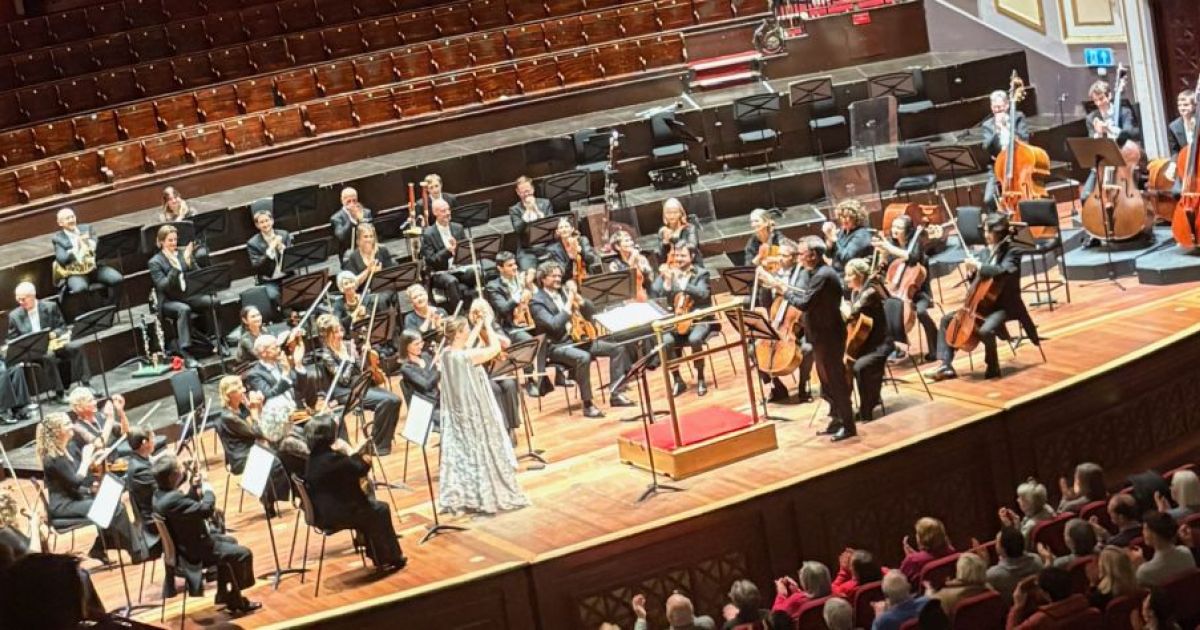
This was a concert beginning and ending with nineteenth century music, and sandwiched between twenty first century. And the composer of the twenty first century music was the evening's conductor. More than that, he was the guest of the Royal Scottish National Orchestra's assistant conductor, Celia Llácer, in the pre-concert talk. This was Jörg Widmann, a man of great talent and reputation who enthusiastically spoke about the music we were to hear, but more importantly why he had composed some of it, and why he had added finishing touches elsewhere.
Marion Wilson, from the front desk of second violins, gave us an honest and charmingly personal welcome before Jörg Widmann was joined by the solo violinist, Veronika Eberle, for Beethoven's Violin Concerto. It was her first appearance with the Orchestra but not with the conductor. For it was she who had recorded new cadenzas for the Violin Concerto written by Jörg Widmann during Covid. We heard those cadenzas played not just by the solo violin but by timpani and double bass. And just as Jörg Widmann had intended, his musical language altered the familiar Concerto - whether for the best, but perhaps better as an interesting alternative.
After the interval came Jörg Widmann's Con brio, a short but very busy interpretation of his musicality intermingled with Beethoven's. In particular, he had told us earlier how it related to the con brio that comes at the end of Beethoven's Seventh Symphony.
The concert concluded with a very fine Mendelssohn symphony, known as his Fifth, but in fact his Second. It is known as his Reformation Symphony and Jörg Widmann had advised us to listen out for the short passage of Jewish sentiment in the middle, despite the composer's strong Lutheran faith. I would be very happy to hear the Orchestra play the Reformation Symphony again, such was the pleasure it brought.
Event: Friday 27th February 2026 at 7.30pm